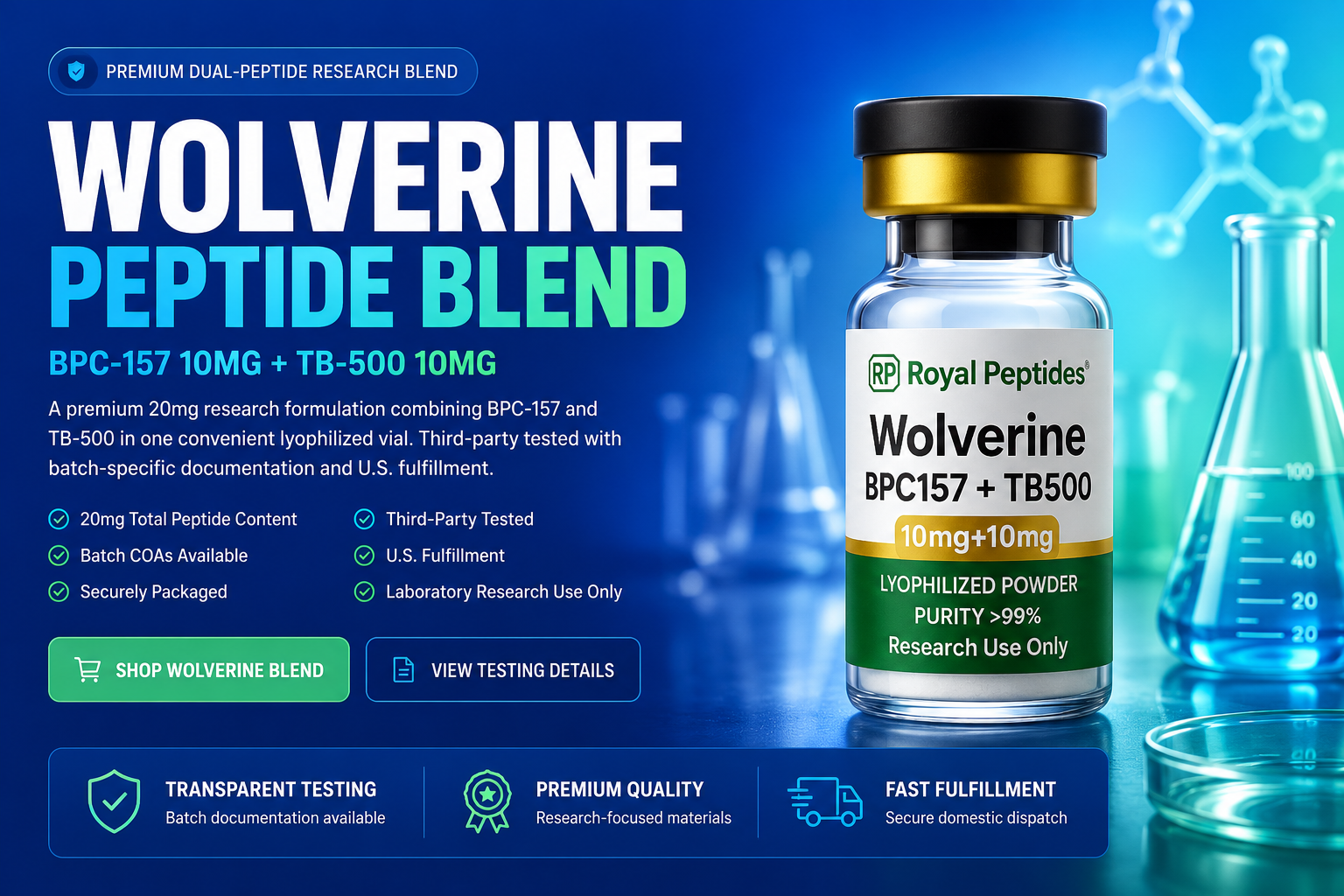
Wolverine Peptide Blend BPC-157 10mg + TB-500 10mg
A premium dual-peptide research formulation combining BPC-157 and TB-500 in one 20mg lyophilized vial. Supported by batch-specific analytical documentation, secure packaging and U.S. fulfillment.

Wolverine Peptide Explained
What Is the Wolverine Peptide Blend?
The Wolverine peptide blend is a dual-component research formulation containing BPC-157 and TB-500. The Royal Peptides formulation contains 10mg of each component, creating a total declared peptide content of 20mg per vial.
“Wolverine” is an informal commercial nickname rather than a scientific classification. The name became associated with this combination because BPC-157 and thymosin beta-4-related compounds are frequently discussed in preclinical research involving cellular migration, vascular signaling, actin regulation and experimental tissue-response pathways.
The scientifically relevant information is the documented formulation: BPC-157 10mg plus TB-500 10mg. Researchers should evaluate any Wolverine product according to its composition, batch identity, testing documentation, handling requirements and intended use.
Component One BPC-157 10mg Cellular and signaling research
+
Component Two TB-500 10mg Actin and cell-migration research
=
Combined Formulation Wolverine 20mg One standardized research vial
Product Information
Wolverine Blend Specifications
Clear formulation details allow researchers to confirm that the material matches their laboratory requirements before ordering.
Product Name Wolverine Research Peptide Blend
Composition BPC-157 + TB-500
BPC-157 Content 10mg
TB-500 Content 10mg
Total Declared Content 20mg per vial
Component Ratio 1:1 mass ratio
Product Form Lyophilized research material
Testing Batch-specific analytical documentation available
Fulfillment U.S. fulfillment for eligible domestic orders
Intended Use Laboratory research and analytical use only
Inside the Wolverine Blend
BPC-157 and TB-500 Research Overview
The two components have been investigated independently in laboratory and preclinical research. Experimental findings should not be interpreted as proven medical outcomes in people or animals.
01
10mg per Wolverine vial
What Is BPC-157?
BPC-157 is a synthetic research peptide consisting of 15 amino acids. It is commonly discussed in preclinical literature involving cell migration, gastrointestinal models, vascular signaling, nitric-oxide pathways, inflammatory markers and experimental connective-tissue responses.
Published investigations are primarily based on laboratory and animal models. These models can help generate scientific hypotheses, but they do not automatically establish safety, effectiveness or an approved clinical use.
- 15-amino-acid synthetic peptide
- Studied primarily in preclinical models
- Associated with cellular and signaling research
- Not approved as a medicine or supplement
02
10mg per Wolverine vial
What Is TB-500?
TB-500 is a synthetic research peptide associated with thymosin beta-4-related investigation. Thymosin beta-4 has been studied in relation to actin regulation, cytoskeletal activity, cell migration, vascular signaling and experimental tissue-response pathways.
Research products using the TB-500 name should be evaluated according to their documented composition, batch identity, manufacturing information and analytical testing.
- Associated with thymosin beta-4 research
- Studied in actin and cell-migration pathways
- Used in laboratory and analytical research
- Not approved for human or veterinary administration
Combination Research
Why Study BPC-157 and TB-500 Together?
A combined formulation allows qualified researchers to investigate both components within one standardized sample. The Royal Peptides Wolverine blend provides a fixed 1:1 mass ratio consisting of 10mg BPC-157 and 10mg TB-500.
The rationale for combination research comes from different but potentially overlapping areas discussed in preclinical literature. BPC-157 research frequently addresses cellular and vascular-response signaling, while thymosin beta-4-related research often examines actin regulation and cell migration.
Important: A combined vial does not prove synergy or guarantee a particular experimental result. Synergy is a scientific hypothesis that must be evaluated through controlled study design.
Fixed Component Ratio 1:1 Equal declared mass of both peptides
+
Single-Vial Format One Sample Simplified research inventory
=
Standardized Blend 20mg Total Consistent formulation information
Areas of Scientific Interest
Wolverine Peptide Research Topics
These areas reflect topics found in laboratory and preclinical literature. They are scientific questions and should not be presented as verified medical benefits.
01
Cell Migration
Research examines how peptide-related signaling may influence cell movement and organization in experimental systems.
02
Actin Regulation
Thymosin beta-4 literature includes research involving actin, a structural protein associated with cellular movement.
03
Vascular Signaling
Preclinical studies may evaluate endothelial pathways and experimental blood-vessel-response signaling.
04
Extracellular Matrix
Laboratory models may investigate collagen organization and extracellular-matrix signaling.
05
Inflammatory Markers
Investigators may measure signaling markers associated with experimental inflammatory-response models.
06
Oxidative Stress
Research may examine cellular-stress and oxidation-related pathways in controlled experimental systems.
07
Gastrointestinal Models
A portion of BPC-157 research involves laboratory and animal gastrointestinal or mucosal models.
08
Connective-Tissue Models
Preclinical research includes models involving muscle, tendon, ligament and related structures.
Third-Party Tested Wolverine Blend
Analytical documentation helps researchers evaluate whether a sample is consistent with its declared identity and purity specifications.
Certificate of Analysis
Quality and Traceability
From Production to Fulfillment
Research-product quality depends on controlled production, documentation, analytical evaluation, packaging and traceability.
STEP 01
Production
The individual research materials are prepared according to defined product specifications.
STEP 02
Purification
Production processes are intended to separate target material from manufacturing-related impurities.
STEP 03
Formulation
The components are prepared in the declared 10mg plus 10mg Wolverine formulation.
STEP 04
Lyophilization
Controlled freeze-drying removes moisture and creates the finished lyophilized material.
STEP 05
Analytical Testing
Representative samples may be submitted for independent analytical evaluation and documentation.
STEP 06
Secure Fulfillment
The research product is securely packaged and prepared for eligible domestic shipment.
Laboratory Handling
Wolverine Storage and Handling
Appropriate storage, labeling and documentation help preserve sample integrity and reduce contamination, degradation and identification errors.
Keep protected from excessive heat, direct light, moisture and repeated temperature fluctuations.
Follow the product documentation and validated storage requirements used by your laboratory.
Prepared research samples are generally handled under refrigerated laboratory conditions using suitable procedures.
Record the batch number, preparation date, solvent, concentration, storage conditions and responsible personnel.
Research Product Comparison
Wolverine Blend vs. Separate Peptides
A fixed-ratio blend offers convenience, while separate materials offer greater control over independent experimental variables.
| Feature | Wolverine Blend | BPC-157 Alone | TB-500 Alone |
|---|---|---|---|
| Composition | BPC-157 + TB-500 | BPC-157 | TB-500 |
| Royal Peptides Content | 10mg + 10mg | Varies by product | Varies by product |
| Component Ratio | Fixed 1:1 ratio | Independent variable | Independent variable |
| Format | One combined vial | Separate vial | Separate vial |
| Research Flexibility | Standardized combination | Independent control | Independent control |
| Research Design | Fixed-ratio combination research | BPC-157-specific research | TB-500-specific research |
A combined research product is not automatically superior to separate materials. The appropriate format depends on study design, controls, analytical objectives and whether each component must be isolated.
Research Purchasing Guide
How to Evaluate a Wolverine Peptide Supplier
Products using the same nickname can differ in formulation, quantity, documentation, testing and fulfillment standards.
01
Confirm the Formula
Verify the declared amounts of BPC-157 and TB-500. The Wolverine nickname does not always represent the same formula.
02
Check the Batch Number
A visible lot identifier helps connect the physical research product with production and analytical records.
03
Review the COA
Check the sample name, laboratory, test date, analytical method, results and corresponding batch information.
04
Understand the Results
Purity, identity and quantity are different measurements. Review exactly what the analytical report confirms.
05
Read Storage Guidance
The supplier should provide clear handling information for lyophilized and prepared research samples.
06
Evaluate the Company
Look for transparent policies, secure checkout, established support and clear fulfillment information.
Product Name
Why Is It Called “Wolverine”?
The name “Wolverine” is an informal product nickname used within the research peptide industry for a blend containing BPC-157 and TB-500. It is not the scientific name of either peptide and is not an officially recognized pharmaceutical or biological designation.
The nickname became popular because researchers and online communities associated this combination with the fictional comic-book character known for remarkable regenerative abilities. Over time, many research suppliers adopted the name as a convenient way to identify a dual-peptide formulation containing BPC-157 and TB-500.
While the name is widely recognized, the scientifically important information is the product’s actual formulation, manufacturing quality, batch documentation, and third-party analytical testing—not the marketing nickname itself.
At Royal Peptides, the Wolverine Blend contains 10mg of BPC-157 and 10mg of TB-500 for a total declared peptide content of 20mg per vial, supplied as lyophilized research material with available batch-specific Certificates of Analysis (COAs).
Commercial Name Wolverine Popular research blend nickname
≠
Scientific Identity BPC-157 + TB-500 The actual peptide formulation
✓
Royal Peptides Formula 10mg + 10mg 20mg total declared peptide content
The Royal Peptides Standard
Why Researchers Choose Royal Peptides
Royal Peptides combines an extensive research catalog with analytical documentation, secure U.S. fulfillment and research-focused customer support.
Available Batch COAs Review available analytical documentation through the online COA library.
Extensive Catalog Access individual peptides, blends, kits and research resources.
U.S. Fulfillment Eligible domestic orders are securely prepared for dispatch.
Secure Packaging Research products are packaged to protect vials and labels.
Educational Resources Use our handling guide, calculator and analytical library.
Dedicated Support Contact our team regarding orders, batches or documentation.
Royal Peptides Research Quality Transparency • Testing • Traceability
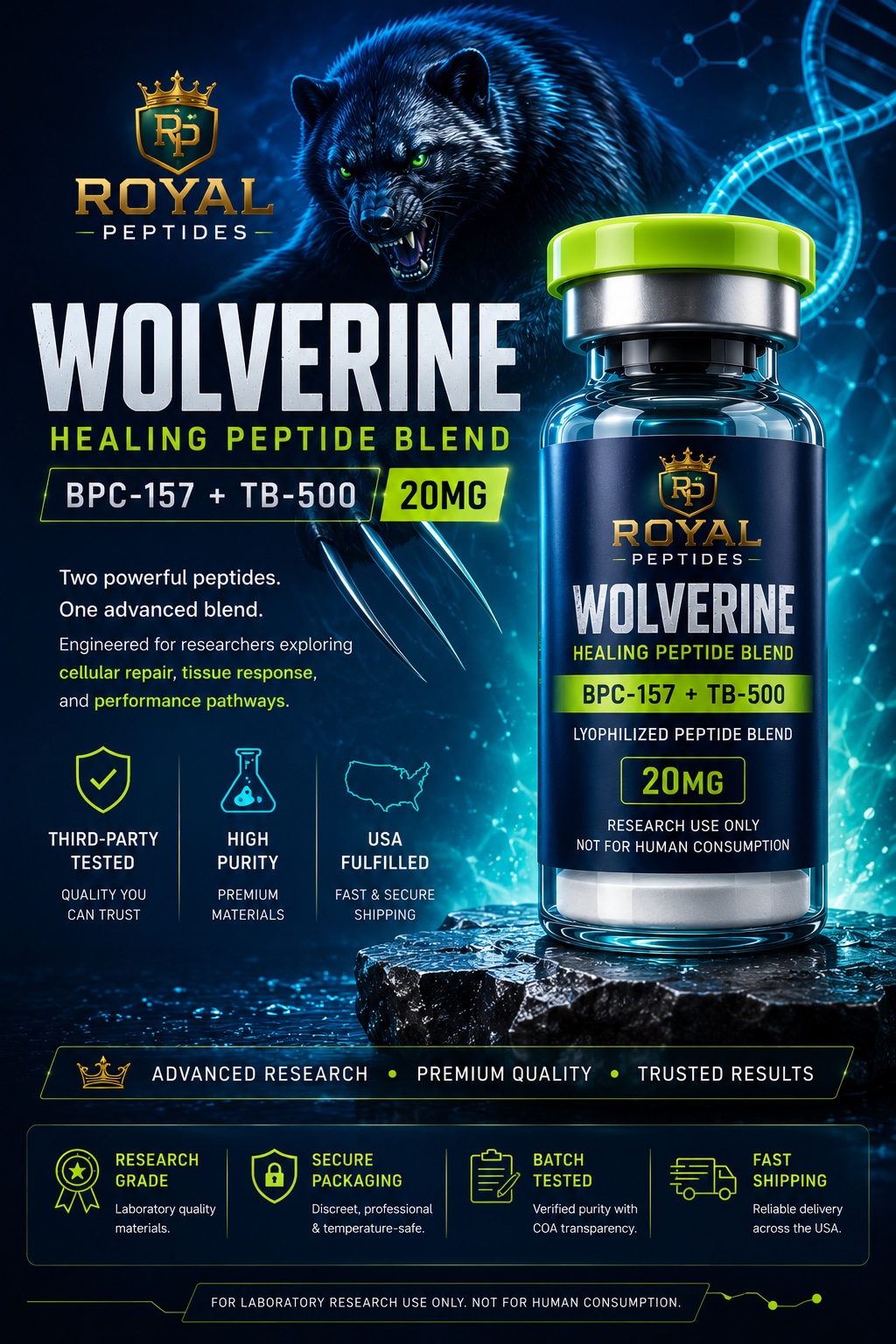
Wolverine Blend
BPC-157 10mg + TB-500 10mg
A standardized dual-peptide research formulation supplied as lyophilized material with available batch documentation.
For laboratory research use only. Not for human or veterinary use.
Continue Your Research
Related Peptides and Research Resources
Explore related individual compounds, research blends, analytical documents and laboratory tools.
Individual Peptide
Explore BPC-157 as an independent laboratory research variable.
View TB-500 products for independent experimental research.
Explore a broader blend containing BPC-157, TB-500,
KPV and GHK-Cu.
Calculate laboratory concentration and measurement relationships.
Read about storage, vial inspection, preparation and documentation.
Review available analytical documentation by product and batch.
BPC-157 Research Peptide
TB-500 Research Peptide
KLOW Peptide Blend
Peptide Calculator
Peptide Handling Guide
Certificate of Analysis Library
Frequently Asked Questions
Common questions about Wolverine peptide, BPC-157, TB-500, testing, handling, storage and research use.
What is Wolverine peptide?
What peptides are in the Wolverine blend?
Is Wolverine a single peptide?
Why is it called Wolverine peptide?
What is the ratio of BPC-157 to TB-500?
Why are BPC-157 and TB-500 combined?
Does the blend prove that the peptides are synergistic?
What is BPC-157?
What is TB-500?
Is Wolverine peptide third-party tested?
What is HPLC testing?
Does peptide purity confirm vial quantity?
What is a peptide Certificate of Analysis?
How do I match a COA to my vial?
What does lyophilized mean?
What should lyophilized Wolverine peptide look like?
Does a broken peptide puck mean the product is damaged?
How should unopened Wolverine peptide be stored?
How should prepared research samples be stored?
Does Royal Peptides ship Wolverine from the USA?
Is Wolverine peptide available in kits?
Can wholesale products be mixed to reach the minimum?
Is Wolverine peptide approved for human use?
Is Wolverine peptide intended for veterinary use?
Does Royal Peptides provide dosage instructions?
Can Wolverine peptide diagnose or treat an injury?
How is Wolverine different from KLOW?
Can BPC-157 and TB-500 be purchased separately?
Why does batch traceability matter?
Can vial appearance vary?
What should I do if my batch number is not listed?
Where can I buy Wolverine peptide for research?
Is this page medical advice?
Premium Research Materials
Shop Wolverine Peptide Blend
BPC-157 10mg plus TB-500 10mg in one convenient 20mg lyophilized research vial with available batch documentation and U.S. fulfillment.
Wolverine Blend is intended strictly for laboratory research and analytical use. It is not intended for human consumption, medical use, veterinary use, household use, or use as a food, drug, cosmetic or dietary supplement. Statements on this page are not intended for the diagnosis, treatment, cure or prevention of disease.